Bitcoin Mania--The World's First Global Asset Bubble

Soooooooooooooo it has been a while since I last posted--personal health issues and the death of a loved one was the reason.

During the last 9 yrs you (and I) have missed the single best investment in the history of the world--bitcoin: a fake financial instrument marketed as a currency has gone up 100s of thousands of percent. Essentially the instrument went from under 1$ to around 19k per coin over this period. Yup no stock, bond, currency, commodity, derivative, or any other financial asset in world history has ever achieved such gains in such a short period of time. Bitcoin the single best investment of all time!!!!!!!!!

Bitcoin is also the world's first and largest global asset bubble. This is not a US thing, Europe thing, or Asian thing. This is a global phenomenon made available by the internet.

Below is the chart which makes you want to truly vomit if you missed it.


Make no mistake this is a bubble which will eventually collapse---however these returns are real and represent real wealth and some people have made life changing profits. If you are a bitcoin holder please remember this: You have won the lottery please lock in your profits and enjoy your wealth.

However They Don't Sell

I have friends who have owned bitcoin since 2010. They have made a killing yet none of these bitcoiners has sold since they believe it will only go higher. This religious faith in cryptocurrencies is widespread and there are over 500 new cryptocurrencies like Ripple, Ethereum, Litecoin, Dash, and Monero just to name a few.

Anecdotal Evidence of a Bubble

1. My mother's dialysis nurses and technicians are "actively trading" bitcoins. These people don't own stocks and never have. Instead, they fancy themselves as bitcoins professionals and have started to trade bitcoin the last 7 months. All feel invincible since the price of bitcoin has gone straight up.

2. They tell my 69 yr old mother who is on dialysis to buy bitcoin because it is a "sure thing" and "easy money." She should get out of her stocks, real estate, and bonds because bitcoin is "the future of money and wealth."

3. Furthermore they say all bitcoin price corrections are buying opportunities---bitcoin is going to 50k, 100k, or even higher. It is guaranteed. The only fear in the bitcoin market is missing out on exponential gains. One dialysis technician bought bitcoin on weakness around 12k on Dec 25th and just "flipped it" for 16k a few days later. He is going to Vegas later in January with these fast easy bitcoin profits.

4. It is okay to use credit cards to buy bitcoin they say. Price appreciation will easily outpace 10-12% interest on credit cards.

5. They tell my mother she needs to get in now or she will miss making millions The fear of missing out is at extreme levels generally associated with historical bubbles like the tech mania from 1998 to 2000.

 
Conclusions 

If this is not a bubble I don't know what is.

Bitcoin is not a currency--currencies don't go up 1000's of percent per year since they are supposed to be a safe secure of value.

Bitcoin is not even an investment anymore. The volatility of bitcoin and its ponzi like structure(people can create/mine bitcoin out of nothing) makes the stock market look safe and secure.

Bitcoin is a global mania driven purely by the fact it is going up parabolically. AKA "you have to buy bitcoin because it is going higher because it has to go higher."

The insanity may continue for much longer than skeptics believe--this is the nature of bubbles.

This WILL END BAD for bitcoin speculators. Cryptos will continue to exist because they make great instruments for conducting illegal actives and money laundering. Want to buy illegal steroids, drugs,evade taxes,etc? You can with bitcoins and the other 500+ cryptocurrencies ha ha.

I wish I had been smart enough to buy bitcoin, but after the theft/fraud incident at Mt Gox (the largest bitcoin dealer at the time) I decided it was not a suitable investment/asset class. Your bitcoins can be stolen electronically by hackers and there is nothing you can do to recover them. Bitcoins are not FDIC insured and the companies holding bitcoins for clients can disappear overnight leaving you with 0 bitcoins.

The parabolic rise of bitcoin will only be equaled to by its epic collapse.

Bitcoin and Cryptocurrency Predictions

The US government and most G-20 countries will begin to finally regulate and eventually legislate bitcoin and most cryptocurrencies out of existence. We have already seen the beginning of this with the latest actions from China and South Korea. No sovereign government will allow bitcoin to replace government backed fiat currency.

Nation states and central banks will introduce their own version of cryptocurrency in the coming years to transfer the world to a cashless economy. This will make every transaction easily tracked, recorded, and taxed by the government in real time.


BSI
Read more >>

Share/Bookmark

How to Improve My Credit Score

Having a good credit score is essential in order to obtain financing at affordable rates and can save you thousands of dollars in terms of interest charges. Here are 7 easy steps to improve your credit score. Why listen to me? I have a 790 FICO score so I know what I am talking about. Enjoy.

1) Get added as an authorized user to your parent's cards (make sure they ask for your SSN). These will report on your credit score and increase your amount of available credit outstanding, thus lowering your overall credit utilization (30% of score). This only makes sense if your parents have never been late on the card and keep utilization low (under 10%). 


2) Check your credit report with the 3 credit bureaus for free at annualcreditreport.com-- you are allowed to access your report once every 12 months. You will not see your FICO score, but it is always valuable to check for mistakes or errors on your report.


3) The amount of credit you get approved for initially is mainly a function of FICO score + stated income. Notice stated income. The credit card companies do not verify your income. Sometimes they will ask to access your tax returns (very rare) and you do not have to provide it to them (app will be declined). Every time you request new credit--they will Hard pull you (negatively effects your score). Sometimes they ask for Household Income--when I was in college I just included my parent's income. Never had a problem. The goal is to get the highest available amount of outstanding credit allowed. This will reduce your overall utilization rate, thus improving your score dramatically.


4) Chase is notorious for Hard Pulls every time you ask for a credit line increase which is why I don't like them. American express however will SP credit line increases. Blue cash everyday 3% on supermarkets, 2% gas, 1% on everything else. Furthermore, AMEX has a special 61 day 3X credit limit hack available. Once you open your new account (HP)--you are eligible for a 3X increase to your credit limit after 61 days--best of all Soft Pull (does not impact credit score) guaranteed. This makes it much easier to increase the amount of credit available--which helps increase your score. Just don't go over 25K or you risk a Financial Review (they temporarily suspend you card and make your prove income, assets, etc).


Another benefit of AMEX is backdating your card. I got my first AMEX 8 yrs ago. Got another one last year. They back date your new card so that it looks like it too has been open 8 yrs. This increases my average age of credit (about 15% of FICO score).


5) Don't forget Discover. They have a new product with their Discover IT card which allows you free access to your real FICO score once a month. They have rotating 5% cash back categories which change quarterly, along with 1% back on everything. Also they will SP credit line increase requests after 3 months. I have this card purely for the free FICO. Some companies scam you buy charging you for your FICO score--this way I get it for free. This card definitely pays for itself.


6) Hit up the MyFico forums--they are the best when it comes to all things credit cards and improving your FICO score.


7) Never pay an annual fee for a credit card.  Most people think they can beat the annual fee by some combination of tricks, and heavy spending. Most fail. Credit card companies are set up to make money. They have complex algorithms that determine who much on average they can make from people. To make this short: don't pay annual fees for cards. They are not worth it in the end.


Read more >>

Share/Bookmark

Fed Chair Janet Yellen on monetary policy: "the best way to build credibility was to lie"


Not new to BSI readers, but Janet Yellen the new head of the Fed admits that the best way to build credibility is to lie to the idiot public. At least she is honest about it, unlike Banana Ben Bernanke. 


From a previous black swan post:

In fact, San Francisco Fed President Janet Yellen mentioned in a speech that central bankers openly lie as a matter of policy. She recounts her discussions with two international central bankers at her first Jackson Hole meeting:
Two of the leading central bankers in the world took me aside to help educate me about how to conduct myself so I would be an upstanding central bank citizen. They offered me the very same advice: Good central bankers never admit they pursue stabilization policy. Such an admission would reduce the confidence of the public in  your commitment to price stability and therefore undermine your credibility and effectiveness as a monetary policymaker. I responded that I appreciated the advice, especially from such distinguished central bankers, but that it left me a bit confused. They seemed to be telling me that the best way to build credibility was to lie, specifically about how I understood the objectives and how I intended to conduct monetary policy.


Am I the only one who wishes we had a more attractive Fed Chairwoman? I mean if we are going to select a woman for the most powerful position in the country, Obama could have done much better. Admit it--you would feel much better being lied to by an attractive woman like this below, compared to grandma Yellen.

On a personal note--women in business suits (with stockings) are incredibly sexy. You mind explodes with all of the possibilities--like ripping of her stockings, what she would look like in various positions on my desk, etc. But I digress.


Read more >>

Share/Bookmark

My Advice to Altria Corp on Ecigs and More


As many readers will know, I am a great aficionado of tobacco stocks and believe they have the single best business model of all-time. They sell an addictive product to loyal customers who literally cannot stop buying their product. Tobacco companies can raise prices every year with little effect on sales (adjusting for the structural decline of the business). And best of all, they pay out large and ever growing dividends to their shareholders. Owning Tobacco Stocks + dividend reinvesting = Long Term Wealth.

Possible Concern of E-Cigs

While traditional tobacco is a great business, new technological advancements such as ecigs have the potential to disrupt this dynamic. I worry that Altria (my largest shareholding) is not doing enough to keep up with the times and may fall behind. So I wrote a letter to Altria to give them a few ideas.

THE LETTER


1. Rethink the company's purpose and strategic vision

Instead of Altria as simply a tobacco company, let's try Altria as a world leader in providing nicotine delivery devices to US adults. The emphasis is on providing US adults a wide range of nicotine delivery options ranging from traditional tobacco products such as cigarettes, cigars, and smokeless moist snuff to newer products like ecigs. With this change in vision, Altria will be able to research and develop new forms of delivering nicotine to adult consumers such as nasal snuff (convenient 4mg pellets that look like inhalers see http://www.snuff.co.in/english_snuff.html#european_snuff for details ) or nicotine infused beverages.

2. Improve and Expand Social Media Presence

While traditional tobacco cannot be marketed through social media channels such as Facebook or Twitter, new ecigs can use social media. Lorillard has an active and very engaging Twitter page with 13K followers. Here all followers certify they are at least 18yrs old to join. This allows Lorillard a powerful marketing tool to directly engage with its valuable customers. As a result, Lorillard's Blu ecigs have over 13K followers and growing. Altria has so far been unable to establish a foothold in to social media. The current number of followers on Altria's Twitter page is 1759. This is a direct result of an inactive corporate account which only recites company press releases. This lack of a social media presence will hurt Altria's eventual roll out of MarkTen ecigs. The new generations of adults 18-21 spend more time on social media sites than traditional avenues available to advertisers like TV, radio, etc.

3. Embrace Ecigs as a way to grow the adult market for nicotine.

A traditional way to think of ecigs is to assume that it will cannibalize cigarette sales. While this will certainly occur, it does not have to be a net negative for Altria overall. With the proper marketing I believe that ecigs and other smokeless products could actually grow the US nicotine market (estimated at 44-46 million smokers). This is a potentially game changing technology that could increase the number of people who use nicotine and arrest the long-term decline in the tobacco industry. In 1965 40% of adults smoked cigarettes compared to 20.8% today. The only reason for the decline is due to health risks associated with smoking. If you can present to US adults a proposition which allows them to consume nicotine while not having to worry about the established health risks of smoking, than it is a win-win. Ecigs are able to reach out to new consumers who would normally never smoke cigarettes because of the negative health effects.

4. Special Marketing for E-Cigarettes

Unlike traditional tobacco products, Ecigs are not currently regulated by the US government or FDA. This has presented early entrants like Lorillard with the opportunity to market ecigs differently than most tobacco products. With the lack of regulatory guidance is opportunity. Lorillard sells its Blu ecigs directly online with a well-constructed website along with traditional retail channels. The website makes use of celebrity endorsements from well-known people such as Jenny McCarthy and online persona's such as "Bob" aka Mr. cool. Furthermore, Blu has a rewards program for purchasing ecigs and refill cartridges to encourage brand loyalty. Altria, meanwhile, has not managed to get a web store up and running for MarkTen yet. In fact, the Nu Mark website only contains general information about MarkTen. Altria needs to take advantage of the current regulatory uncertainty and actively market MarkTen similar to Lorillard. Simple convenience store displays are not going to enough. Your competitors are already utilizing TV ads to promote their products. They are trying to lock in as much market share of the ecig market as possible before regulatory restrictions ban the practice. One way Altria could roll out MarkTen would be to product launch on social media like Twitter and Facebook along with more traditional events. Give away some MarkTen's to age verified consumers and encourage them to review it and share with their friends. Best advertising is word of mouth especially when it comes to new technology.

I will leave you with a story which shows the potential for Ecigs. I was in a DMV last month (always a fun experience), and a man next to me started smoking an ecig. Four people came up to him to inquiry what this new device was and whether he was smoking? He said no, it was all water vapor. People were amazed and enthralled with this new technology, and more importantly, no one asked him to stop or move outside! Social stigma of smoking gone! 
 
BLACK SWAN INSIGHTS
Read more >>

Share/Bookmark

Don't Believe the Hype: Apple is Not a Cheap Value Stock

A quick blurb about Apple's earnings.

Apple reported earnings last night which beat already lowered expectations. Little surprise. Under-promise over deliver as usual. However, guidance was very poor. That has not stopped the usual Apple groupies from proclaiming that Apple has become a value stock with a growing dividend and share buybacks. This is completely false.

On the surface Apple appears to the layman cheap. Compared to 2013 earnings expectations, Apple trades at a 9 P/E and a forward P/E of 8.3. What more could a value investor want? The reason that Apple is trading at a low valuation because everyone expects earnings to decline in the future. This is a key aspect which most investors fail to realize. When a non-cyclical stock trades at a P/E of lower than 10, the market is expecting declining earnings--analysts just have not realized this yet. In fact the market is expecting a sharp decline of at least 20% compared to analyst's 49.00 in earnings expected for FY 2014. The concept that Apple is cheap is noting more than a stock market mirage created to suck in low-informed investors into a massive value trap. If anything, Apple is a short not a buy at $414 a share. Expect it to steadily decline over the next year as more and more investors realize that the growth will disappoint to the downside.

And remember--those stock buybacks are nothing more than a waste of shareholder money. Buying back stock at inflated prices when earnings are declining is a recipe for disaster. I pity anyone owning Apple (e.g Greenlight Cap and about a billion other hedge funds). The Apple Titanic is sinking, better abandon ship before the whole thing sinks and there wont be enough lifeboats for everyone.

Black Swan Insights.
Read more >>

Share/Bookmark

AP's Fake Terror Tweet: The Beginning of For-Profit Terrorism?

Historically, most terrorism was committed for ideological reasons, but now a new form of terrorism may be emerging: for-profit terrorism.

On April 23 2013 AP's widely followed Twitter account was hacked and falsely reported that an explosion had occurred at the White House injuring President Obama. Normally such a report would have little impact, but with 2 million followers, AP's tweet translated into real world consequences for US financial markets. Before the false tweet, US markets were enjoying a rally of about 130 points on the Dow and 14 points for the S&P 500. Within 3 minutes of the fake AP tweet, the S&P 500 had crashed 13 points with large gaps seen in many stocks. Zerohedge reports that during that time 260,000 S&P contracts traded with a notional value of $20.4 billion. A large amount of money was made and lost during this time, all because of a fake news report on a twitter account. While this instance was isolated and minuscule in the general course of the stock market, it may mark the beginning of a disturbing new trend where terror is used for financial gain.

The rapid dissemination of information through mobile and social media is a double-edge sword. People are more connected to their friends, families, and employers despite living 1000's of miles apart in some cases. Information is no longer controlled by a top-down mainstream media hierarchy which was vetted by editors and producers before dissemination to the masses. Instead information can now be transmitted almost instantaneously be anyone with an Internet connection, bypassing traditional forms of media such as TV or radio which had controls to prevent false or unsubstantiated stories from breaking. This new form of unedited information has the same power to change the course of events as traditional mainstream media information. Malicious actors (whether state-sponsored or independent) could use this new technology to make money.

Consider the following example. A man in Times Square starts shouting that the President has been shot and is dead. He runs around telling everyone that he has a source at the White House that told him this was true. What would be the effect of this false statement? Most likely nothing. Some by passers may get upset and call the police to report the deranged man for making threats against the president. The point being that no real world impact occurred. Most likely, the event will be considered a non-event and not covered by the media.

Now consider another example. Hedge fund Alpha wants to make a quick buck in the stock market. Hedge Fund Alpha purchases the services of an accomplished hacker to break into the twitter account of AP and post a false report that "Terror in DC--the president shot and killed at public reception--- foreign terrorists thought responsible--Washington on lock down--more news coming". Knowing that this headline would cause the market to drop precipitously, Hedge Fund Alpha shorts a large amount of S&P 500 futures or buys puts. Within minutes, Hedge Fund Alpha has made millions of dollars and promptly closes its positions. After 10 minutes, information comes out that this was a false report and that AP's twitter account was hacked. The White House Press Secretary tweets that the president is fine and all is well in the West Wing. AP asks Twitter to suspend its twitter account in order to prevent further misinformation from occurring. The problem is that the damage has already occurred. Investors lost money as stocks plummeted, while Hedge Fund Alpha collected large profits. Keep in mind that this whole event happened in less than 10 minutes. What was the cost of this illegal hack operation for Hedge Fund Alpha? The answer is not much compared to the millions in potential profits. All the hedge fund had to do was to hire a hacker and not tell them what the hack attack was designed for. You could probably hire a computer hacker for a trivial amount (lets just say $50,000), provided they did not understand the goal of the operation.

The above example illustrates how simple and cost-effective this fake terror story could be generated and disseminated to the world. While the story was quickly debunked as a false news item, it succeeded in its objective by creating a temporary panic in the stock market,  allowing nefarious operators to make some fast money. While this fake terror scenario was relatively benign (e.g. no one was physically hurt or injured), the incident raises an important point regarding terrorism: it can be very profitable.

Now suppose Hedge Fund Alpha wants to go a step further and actually influence events by committing a low-scale attack against a specific company in order to profit from the events. In this scenario, the attack could be a cyberattack against a company which primarily relied on its website to make money (e.g. Amazon.com, Google, etc). This is not without precedent. Many companies over the last few years have reported denial of service attacks against their websites. However, for the most part these attacks are done by disgruntled low level hackers who take down the site for a few hours at most. Sometimes they post explicit or incorrect images on the website, like seeing a naked woman when you go to bankofamerica.com. Sure its embarrassing for the company, but does little to impact corporate profitability or stock price. Now imagine that a well financed organization with millions of dollars in capital engaged in a well coordinated and persistent attack which shut down Amazon.com. Just when Amazon thinks it has restored the website, the hackers slip a malicious virus into Amazon's network which artificially lowers the price on every item to $1. These kind of well planned attacks continue for 6 days until Amazon finally regains full website functionality. A few days later Amazon announces that the hack attack also resulted in credit card information on millions of customers to be stolen. This attack would have cost Amazon 10's of millions of dollars of profit and hundreds of millions in revenue, along with a serious breach of public trust in the company. There is no question that the stock could decline during the whole incident, a positive for anyone betting against the company through short-selling or puts.

While the above scenario is unlikely considering how large Amazon is and the thousands of computer technicians it undoubtedly employs, this is not the case for smaller companies who could not defend themselves against such an organized and persistent cyberattack. For smaller or weaker companies this attack could very well force them into bankruptcy. We have entered a new world where this type of scenario is possible.

Black Swan Insights


Read more >>

Share/Bookmark

MACRO UPDATE: Buy, Sell or Hold?

Well. I am finally back to the blog after a very long and pleasurable hiatus.

I am going to begin publishing a weekly survey of the current macro environment with my various trading positions and predictions.

1. S&P 500 Position: Neutral/with downside bias (e.g.would wait for a correction before buying stock).

If somebody put a gun to my head and forced me to by a stock I would chose a consumer staple stock over cyclical. The best stocks on earth are the tobacco stocks like Altria (MO) and Lorillard (LO). They pay 5% dividends which increase over time. They have a captive customer who is physically and mentally compelled to purchase their product. Buy. Hold. Reinvest Dividends. Retire Rich.


Furthermore, sentiment is too high as indicated by the NAAIM Manager Survey sentiment which currently stands at 85%. Anything over 80 indicates a top for the market.


2. Gold & Silver Position: Buy/Accumulate

Gold has corrected over the last few months and represents a good entry point. With the Fed promising to print money forever, why not own gold? I am happy that I get to buy gold on sale around $1580-1600. Furthermore, the large commercials have dramatically cut their short positions, indicating that they expect higher prices. HSBC noted that gold fundamentals remain positive because of "rising global liquidity as the likes of the Bank of Japan ramp up quantitative easing, rising inflation expectations, currency depreciation and geopolitical tensions."


Furthermore, the Cyprus crisis is likely to keep a bid under gold writes UBS:

"For now, the risk of immediate contagion to otherperipheral countries remains limited, but the Cyprus precedent certainly cannotbe shrugged off particularly if things deteriorate elsewhere...As people start to worry about the safety of their deposits, gold would become an attractive alternative and an escalation of these worries would prompt a return of fear-related physical buying."

3. Oil Position: Sell/Short

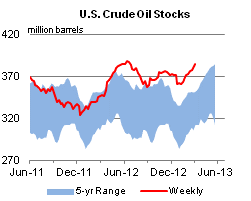
Too much oil and not enough places to put it sums up the oil market. The chart below shows the surplus amount of oil slushing around the US. US oil consumption is declining and production is growing. Not a good combination for Crude oil. Furthermore, speculators are long crude, which means it is likely to go down. Always fade the crowd my friends. It is not a guaranteed win, but puts the odds in your favor.


And this trend of massive over-supply is expected to worsen: "According to early estimates from four analysts surveyed by Dow Jones Newswires, U.S. crude oil inventories rose by 1.1 million barrels in the week ended Friday"

4. Treasuries Position: Neutral

No reason to buy treasuries. The Fed is manipulating the market with its "QE till we all die" policy. Rates will remain low despite the improvement in the economy and higher inflation expectations. There is no bond bubble and it will not burst. The Fed will not allow this. If you are dumb enough to own Treasuries beware. The government is printing money to debase the dollar. You will always get your principal back with interest, but will likely lose substantial purchasing power due to inflation in the future.

5. Residential Real Estate Position: BULLISH BULLISH BULLISH.

If you can qualify for a 4% or less mortgage, this is the best time to buy a home. The Federal Reserve led by kamikaze Ben Bernanke has lowered mortgage rates to near all-time lows. If you buy a house, you are in essence betting on inflation which is exactly what the Fed is trying to engineer. This bet is going to pay off for you in a huge way in the future. You would have locked in a super low interest rate of 4% when historical inflation is 3%. This means that in real inflation adjusted terms, you are borrowing money for 1%. Great deal for consumers. Furthermore, with the illegally printing money, homes prices should increase over the next 1-5 years substantially (10-20%). If you put 10% down, a 10% increase doubles your investment.

6. Trade for the Week Position:

 Buy Imperial Tobacco (ITYBY.pk) This is the ADR for Imperial Tobacco company which is a large multinational tobacco company with steady profits and addicted customers. Not a bad combination. The stock has strong support at $70.40. I expect a bounce to $73.50.


Happy Trading Everyone!

Black Swan Insights
Read more >>

Share/Bookmark

Buying GLD: A Golden Opportunity For Contrarian Investors

Back from hiatus. As frequent readers will remember, gold remains a core part of my portfolio (since the beginning of QE madness from the FED). However, from time to time I will take a trading position in the yellow metal when opportunities present themselves. Well, that time is now upon us. I am buying GLD.

Why?

Gold has been in a downtrend since reaching its high back in 2011 around $1913. Recent selling has been initiated on the (I believe) false assumption that QE 3 is off the table. Wrong! Another month of weak unemployment numbers will almost certainly force the Fed into more QE (maybe sterilized in some form) to force long term interest rates even more. QE=Money Printing=Dollar Debasement=Higher Nominal Asset Prices. No rocket science here. 

However, the market has failed to realize that QE is back on the table. This case is especially true in Europe where the ECB will be forced into doing more to stop the bleeding. The European public does not want more austerity (outside of Germany). They want more government spending financed by money printing. ECB will initiate more QE or expand its current refinancing operations. 

Sentiment on gold is extremely negative which from a contrarian perspective is positive. According to the Hulbert gold newsletter sentiment index (a collection of market timers) the crowd is now short gold-- Here is an excerpt, "Today, in contrast, it is at minus 14.8%, which means that the average gold timer is now allocating about a seventh of his gold-oriented portfolio to shorting the market."

As usual these professional market timers are almost always wrong. They are bullish at the top of the market and bearish at the bottom. So I will be happy to buy when they are shorting.

Obviously, gold could go lower, but the odds favor that we are approaching a major bottom in gold.


Black Swan Insights
Read more >>

Share/Bookmark

Scared To Death: Investment Manager Sentiment Plummets to March 2009 Levels


Considering that the market has done nothing for the last few weeks, except bounce up and down in a very tight range, one would think that sentiment has cooled off from August's market crash. You would be wrong. The NAAIM sentiment survey released today shows that investment managers are practically on the ledge and ready to jump to their own deaths to escape this vicious market turmoil. Apparently, they just realized that their end of year bonus is not going to be filled with gold or jewels, but instead with a lump of coal thanks to their poor performance. NAAIM sentiment came in at 4.18, a level not seen since the March 2009 lows. This also means that investment managers are so depressed that they are almost completely net short (with leverage). It should be remembered that this is a contrary indicator. You generally make money by doing the exact opposite of these pigeons. Right now it is saying that we may be nearing an important low in the market. This is quite interesting because other sentiment indicators like the AAIII poll are not confirming excessive bearishness.

One thing to keep in mind when trying to use this indicator for market timing. Back in March 2009 when the market was bottoming, the NAAIM survey held below 10 for three weeks. So it is not a perfect timing indicator, but certainly one worth following.

3/4/2009      2.15
3/11/2009    4.23
3/18/2009    9.97


Black Swan Insights
Read more >>

Share/Bookmark

Quick Update: Closing Sugar Short

All good trades must come to and end as they say. The time has come for my Sugar short. I caught a nice 14% downside move that was pretty much straight down. It would be piggish of me to press the short any further. When you trade on leverage, you cannot risk a large oversold bounce (you never know if it is the beginning of a large move higher or just a technical bounce).

So why did this trade work so well? Luck. When I shorted sugar the fundamentals were beginning to sour along with a negative technical backdrop. Furthermore, all soft commodities were weak during this period, which pressured sugar lower. In short, the general conditions favored lower sugar prices.


I might consider shorting sugar again on a possible bounce higher.

Related Articles

Shorting Sugar
Update on the Sugar Short


Black Swan Insights
Read more >>

Share/Bookmark

Will the EU Bailout Save the Market? Be Careful What You Wish For


The endless and increasingly desperate rumors of an EU bailout was enough to juice the stock market higher today. The Dow closed up over 270 points. To me, this has ominous parallels to the October 2008 Tarp bailout of the banks. If you remember the market initially dropped when the US House of Criminals Representatives failed to surrender complete sovereignty to the major banks. A few days later, the big banks made the right payments to the right people to get the TARP bailout approved despite public opposition to the plan. Anyway, the key takeaway was that the stock market immediately began to crash after the passing of the TARP bill. Instead of restoring confidence, the bailout bill spooked the market. People started to freak out that the US financial system must be in deep trouble if it needed $700 billion in additional capital. After all, every Government official and Fed member had assured the market that "the fundamentals remain sound" and other lies.

Below is a chart of the S&P 500 between October 3, 2008 (when the TARP bill was approved) and October 17,2008. The market crashed 22% despite the bailout. The lesson from 2008 was that bailouts don't prevent markets from crashing. Are we repeating history?


Black Swan Insights
Read more >>

Share/Bookmark

Update on the Sugar Short

A few days ago I mentioned that Sugar was a good short from both a fundamental and technical view. So far the trade has done well. The longs are currently in liquidation mode as market sentiment has changed dramatically. A few weeks ago the bulls were focusing on Brazil's weak crop estimates. Now, everyone is worried about the expected global sugar surplus of between 4-7 million tons for the 2011/2012 season. Furthermore, the risk on market sentiment has been turned off courtesy of Europe's financial implosion.

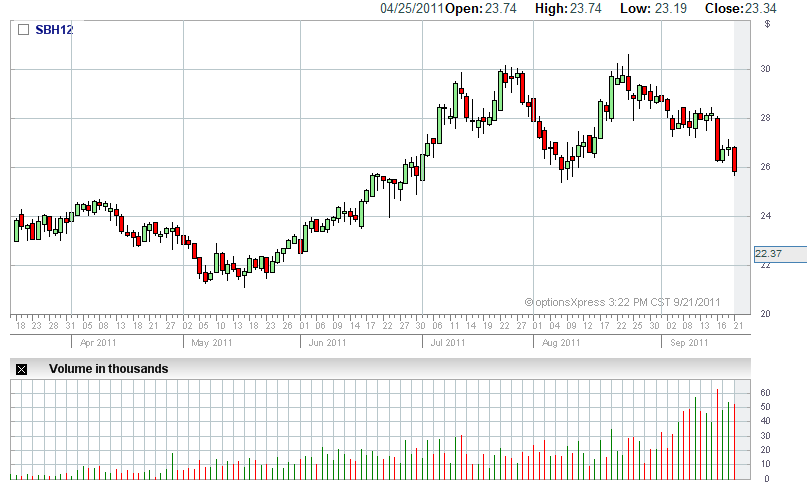
This situation represents trouble for the sugar bulls as the market is heavily long sugar. The sugar market is also at a key technical level. See chart below


March Sugar is currently trading at 25.84, which is just above the early August low of 25.38. If sugar fails to hold this level than it exposes 24 as the next downside target. If 24 is breached then we could see sugar fall to 22.

Volume, as you can see from the chart is starting to pick up as spec longs sell their losing positions. Adding to the bulls' woes, the CME's margin hike made it a little more expensive to hold sugar.

I remain short Sugar.

Black Swan Insights
Read more >>

Share/Bookmark

Shorting Sugar


With the market gyrating back and forth with no real conviction either way, I have been looking for uncorrelated trades, which can protect me from the non-stop risk on/risk off algo controlled market. Well I think I have found an interesting short opportunity: Sugar. 

Below is a chart of SGG, the ETF which tracks Sugar. 


You can see from the technical setup that Sugar is looking very heavy, with a possible double top pattern. Along with a weak technical picture, Sugar also faces poor fundamentals. The market is expected to be in surplus of at least 5 million tons for the 2011/2012 season. The only news that supports the market is a lower than expected harvest out of #1 exporter Brazil. However, this decline in output will be easily offset by record crops in Thailand, Europe, and India, along with strong harvests out of Russia and Ukraine. So we have a situation where the price of sugar has been bid higher on Brazilian crop concerns, but this should be short lived as market participants realize that the market will be well supplied. 

Another reason I like this trade is because sugar has a very low correlation with the stock market (around 0.1), which provides at least some diversification.

Finally, the sugar market is dominated by long speculators right now. Non-commercial traders are currently long 155,000 contracts, meaning that they will be quick to sell on any decline. Another bearish indicator is the fall in open interest, signaling a lack of conviction in this latest up move.

The trade is pretty simply. Short SGG with a stop at 105. 


UPDATE 9/16/2011---Well obviously I got really lucky on my timing on this trade. At the time of this writing 11:18 am pst, Sugar is down over 5% on a Canplan report, which suggests the Brazilian sugar crop will be stronger than expected. I am still short. There will much more long liquidation in the days to come.

Black Swan Insights   

Disclosure: I am short SGG at 100.40
Read more >>

Share/Bookmark

Merger Arbitrage Opportunities---Free Money....But

With the recent chaos in global markets, merger arbitrage spreads have widened considerably. This has made the risk/reward more favorable, allowing enterprising investors to take advantage. Below are some of the best opportunities in the merger arbitrage area:


From Dow Jones


Varian Semiconductor Equipment Associates Inc. (VSEA), Applied Materials Inc.(AMAT) 
 
Premium offered: $1.03 or 1.66% 
Acquirer: AMAT 
Target: VSEA 
Offer per share: $63.00 cash 
Value of outstanding common equity: $4,752,090,000 
Target share price: $61.97 
Acquirer share price: $11.05 
Expected closing: End Of 2011 9/25/2011 (might be October at the latest) 
Annualized gain: 37.92% 


Motorola Mobility Holdings, Inc. (MMI), Google Inc. (GOOG) 
 
Premium offered: $2.40 or 6.37% 
Acquirer: GOOG 
Target: MMI 
Offer per share: $40.00 cash 
Value of outstanding common equity: $11,772,000,000 
Target share price: $37.61 
Acquirer share price: $533.51 
Expected closing: End 2011-Early 2012 1/1/2012 
Annualized gain: 20.39% 

I don't normally like merger arbitrage because the risk is generally too high and the reward is too low. However, with these kind of annualized returns and ZIRP by Banana Ben and his merry traitors at the Fed, these look like good opportunities, without having to bet on the direction of the stock market. After all, anything is better than 0% at your bank. 

Warning: Merger Arbitrage often seems likes a sure thing...and it is until one of the deals falls through and you watch the stock drop 20-30%. The deals listed above are both all cash deals and have a very high likelihood of going through. But no guarantees. 
  
Black Swan Insights
Read more >>

Share/Bookmark

Marc Faber's September Outlook: The Calm Before the Storm


Marc Faber is out with the latest issue of his famous Gloom, Boom, and Doom Report which is always a must read for serious investors. Unlike most of the other talking heads, Faber has an excellent track record. He correctly predicted the top in the equity markets in Nov 2007 and caught the bottom in March 2009, making his subscribers a lot of money. Here is a summary of his September 2011 report:


1. Stocks---Faber says stocks face two potential outcomes: a brief rally to between 1250-1300 on the SP 500 before another leg down (and breaching the 1101 low) or a prolonged trading range with 1100 being the low and 1300 as resistance. Faber thinks the first outcome is more likely, but this could change depending on Fed policy (aka: money printing). Another reason for Faber's bearish posture is the unfavorable seasonality of September (worst month for stocks historically). Investors who have exposure to stocks should use any bounce to sell. If you feel compelled to own stocks, Faber recommends blue-chip stocks like Pepsi and Johnson and Johnson.


2. Gold--Extremely overbought at this level. Could fall to $1500-1600 range during the correction. Faber noted the bizarre relationship between US treasuries and gold. Concludes that the people buying gold were not worried about inflation but a collapse of the entire financial system. Gold should be viewed as more of an insurance policy rather than an inflation hedge. Long-term gold is going significantly higher. Gold stocks may be the better bet than the physical metal in the short-term as they play catch up.


3. US Treasuries--After a huge, fear-inspired rally, US treasuries are extremely vulnerable to a correction. Faber notes that the Daily Sentiment Index is around 98%, indicating a possible top. Furthermore, the "dumb money," a.k.a. the retail crowd, is very bullish judging by their positioning in the Rydex inverse government bond fund. If you own Treasuries, now is time to take profits.  


4. Indian Equities (Sensex)--While generally bearish on equities, Faber would advise the gradual accumulation of Indian shares, noting that they are relatively cheap and represent good value. Over a longer time frame (10 years), Faber thinks Indian stocks could appreciate 7%, which is pretty good compared to other investment options.


5. Macro--"This system has become completely corrupted and is being run for the benefit of the billionaires and banking CEO's who have control of the politicians." Faber has harsh words for Warren Buffett, noting that the investment guru profits not because of his genius, but at the expense of the American taxpayer. Buffett represents the very worst when it comes to crony capitalism. His BAC investment will likely prove very profitable, courtesy of the taxpaying middle-class and Buffett's straw man President whom he controls.


Happy trading!

Black Swan Insights

Read more >>

Share/Bookmark

Nasdaq Sentiment Index Hits All-Time Low---A Contrary Buy Signal?

The last time this indicator fell by so much was back on June 13 2011 when the NASDAQ sentiment index hit -194. We mentioned (see Negative Sentiment Suggests A Near-Term Bottom) that from a contrary perspective, this was a short term buy signal with the markets likely to rally. SPY was at 127 on June 13th. By July 7, SPY had risen all the way to 135.

Well it is that time again. The NSI has hit a new all time low of -342, showing just how much fear is currently priced into the market. This is a bullish signal for contrary investors who buy fear and sell euphoria as Jim Rogers would say.

I expect the market to trade sideways for a while before the new leg higher. Similar to what happened in late June of 2011. It would be hard to imagine a significant fall from these levels barring some kind of European Lehman event.

click chart for larger image.


Black Swan Insights
Read more >>

Share/Bookmark

Investment Ideas from the Barron's Roundtable


Find out what the word's top investors are doing with their money during these tumultuous times.

Bill Gross of PIMCO-- "Our best idea therefore is a 10-year Australian or Canadian bond. A 10-year Canadian government bond yields 2.5%. A10-year Aussie bond yields 4.5%. "

Marc Faber--In the near term the stock market is oversold, and a bounce to between 1240 and 1280 on the S&P 500 is possible. New highs above the May 2 high at 1370 are most unlikely for next six to 12 months.

I'm not buying anything right now. But if stocks dropped another 10% to 20%, I might add to the positions I mentioned in the Midyear Roundtable. I also maintain my recommendation to short Salesforce.com [CRM]

Gold is likely to correct, possibly by $100 or $150, but I continue to recommend gradual accumulation.

Archie MacAllaster-- I like some of the insurance companies more than the banks. Hartford Financial Services [HIG] has a book value of $43 a share, and the stock trades around 19. It yields more than 2%. Hartford raised its dividend this year to 40 cents a share from 20 cents, although it was a lot higher before the financial crisis in 2008. Hartford could earn $3 a share this year, so on a price/earnings basis it is very cheap.

Fred Hickey---  I stay with my secular bull-market play in gold. I own bullion and gold exchange-traded funds. The better opportunity right now is in gold-mining stocks. They have underperformed for a while. They are going to get a huge boost on price alone. I like Agnico-Eagle Mines [AEM], Newmont Mining [NEM] and Yamana Gold [AUY] for the second half of the year.

We were short since May a dozen semiconductor stocks, but I have covered them. I wouldn't be short anything now, because I don't know when the Fed is going to pull the trigger on QE.

Felix Zulauf ---I predicted in the Midyear Roundtable ("Buy Low, Stay Nimble," June 13) that
the stock market would go to a low in the fall. The next few weeks will be extremely volatile. I expect the market to go below the latest lows in September.

The central bank will come in to provide liquidity, but timidly at first because the Fed was bashed for QE2. After the fall low, equities will recover part of what they lost into the turn of the year and then fall again. Economies around the world most likely will be in recession next year.
Confidence in our currencies, policy makers and central banks is going down the drain. That will be reflected in a rising gold price. I have long said this isn't an environment for investing in stocks. Hold cash in the form of short- to medium-term Treasuries. Own a lot of gold, and don't have debt.

Mario Gabelli --The volatility we saw in the markets in May 2010 --  hedge funds trying to protect themselves using ETFs [exchange-traded funds] --  has returned, with the result that good and bad stocks are getting crushed. It is hard to figure out where to allocate and reallocate capital. On the other hand, we are getting pretty decent cash flows in certain products such as utilities, where we have taken advantage of the decline in stocks like NextEra Energy [NEE]. One position to which we have added is National Fuel Gas [NFG]. Shares of the company, which is partly a utility and partly a shale-gas play, fell to 55 from
75.
-------------------

I have failed to include Abbey Joesph Cohen's view because she is a certifiable lunatic who only gets paid to pump stocks to retail investors. As such, her opinion is worth less than rat excrement and would only serve to harm readers. 

Black Swan Insights
Read more >>

Share/Bookmark

Did We See the Plunge Protection Team Last Night?


Last night was a strange trading session. The Asian markets followed the US down. The Nikkei was off 4.5%, Kospi down 8%, and the ASX 200 was down 5%. As a result SP 500 futures plummeted another 28.50 points to around 1080. Then the unexpected happened--within a 20 minute period some massive buyer came in and starting lifting all bids in the market. The SP 500 futures almost immediately gained 14 points and went on to recoup all overnight losses. Then futures turned 1% higher. This is a stunning move considering the market was in free fall at the time.


I don't have any proof, but we may have just seen the plunge protection team in action. Just when everything in the world is going to hell, there always seems to be a mystery buyer come in to save the market. The huge move in the SP futures was not in response to any news, which makes the situation very suspicious. I doubt the SEC will ever investigate this considering how busy they are watching tranny porn (see ABC news article).

Oh well, back to your regularly scheduled market manipulation courtesy of the Fed.

Black Swan Insights  
Read more >>

Share/Bookmark

Charting the Stock Market Crash of 2011

Amazing charts show the massive carnage.

Here is a chart of the % of S&P 500 stocks above their 50 day moving average. We are at the same crash levels back in October of 2008.


S&P 500 stocks above 200 day average--its low, but has been lower.


The CBOE Equity put/call ratio--generally a contrarian indicator. We are near the highs reached back in 2008. Everybody wants to buy puts near the bottom.


The VIX--otherwise known as the fear index shows the real fear in this market. We either get a Lehman event or we are near capitulation.


SP 500 Bullish sentiment--not near the lows seen during October 2008 or March 2009, but getting very close.


Baltic Dry Index--used to be a good leading indicator. It is hovering just above 2008 lows.


Based purely on technicals, the market has only been this oversold twice:  5/21/40 & 10/19/87.  The SPX was +9.4% and +8.1% a month later according to Sentimentrader.com

While the AAII investor sentiment will be released on Thursday--we can imagine that it is somewhere around 5% bullish and 95% bearish.

Comment: Don't listen to the fools on CNBC saying it is time to be defensive--the time for that was 2 weeks ago before the crash. Now is the time to buy safe stocks for a tradable bounce in the markets. I like tobacco stocks and MLPs (with no commodity risk). 

Black Swan Insights
Read more >>

Share/Bookmark

Economy on the Brink--The Fed's Next Move


With the Fed meeting tomorrow, everyone wants to know what the Fed's next move after this dramatic crash. This is a re post of a previous article which explains the Fed's options during a liquidity trap.

1. Dramatically Change Price Expectations---Recent Fed announcements indicate that they want a 2-3% inflation rate compared to the current 1% rate. One idea is for the Fed to increase its inflation target upward to between 4-6%. To support this new policy the Fed could openly announce that they are monetizing debt rather than calling their money printing--credit easing. The Fed could also buy new kinds of assets such as stocks, corporate bonds, land, etc. This could have the effect of stimulating spending as consumers and businesses fear the loss of purchasing power. It would make it clear that the Fed is serious and will do everything in its power to create inflation.

2. Cap Treasury Rates (Aka. Operation Twist)--Under this policy option the Fed would agree to cap treasury rates at unreasonably low rates (e.g 10 year at 2.0% and 30 year at 3.5%). They would openly announce the target to the market and state that they will print as much money as necessary to achieve the goal. This would have the effect of lowering the real inflation adjusted yield of the 10 year to below zero. It would reduce the incentive for financial institutions to hold Treasuries and force them to do something with their money.

3. Taxing Currency---- Under this option the government would tax the currency, meaning that the dollar would automatically lose value over a period of time (say 3% every 6 months). This would create a cost to holding currency, giving people and institutions an incentive to spend it quickly, which would increase the velocity of money throughout the financial system. An extreme example of this policy would be the introduction of a new currency, which would lose a certain amount of value over a fixed period of time. The Japanese government considered this option in 1999, but never implemented it.

4. Negative Interest Rates--Like taxing currency, this option imposes a cost to hold money and theoretically forces people and corporations to spend money, which would increase aggregate demand. However, this is a hard policy to implement from a political perspective. It could lead to a flight of capital from the US as savers abandon the dollar for foreign assets. Under this policy option you may have to implement capital controls. What could work is for the Fed to impose negative interest rates on bank deposits held at the Federal Reserve. They could also prevent banks from passing along negative interest rates to consumers. Banks would be forced to do something with all of the money they are hoarding. This policy option would give banks an incentive to lend to the economy.

5. Reduce the Interest Paid on Excess Reserves---One reason QE failed was because banks simply held onto all of the excess reserves created by the Fed. All of this money is simply sitting around doing nothing for the economy. The Fed could reduce the rate it pays on these excess reserves, thereby creating an incentive for the banks to lend the money. While this appears to be a logical policy option, it is not practical because the major banks are largely insolvent. They need the capital to cushion themselves from future credit losses. Even if the Fed was to reduce the rate paid on reserves to 0%, it would not be enough to encourage the banks to lend out the money.

6.Extend Duration of Balance Sheet--Under this option, the Fed would start to move its bond holdings into longer dated Treasuries. The idea would be that the Fed would indicate to the market that it is going to maintain easy monetary policy forever. However, this action would be a de facto admission that QE 1, QE 2  was debt monetization. The last bit of confidence left in the dollar would collapse . The whole goal of QE was to con Americans and foreigners into believing QE was temporary and would be reversed at a later time (readers know better than that). If the Fed starts buying 30 year treasuries, it collapses the illusion forever.  

7. Helicopter Drop Money--The easiest way to stimulate aggregate demand is to print money and hand it out to the general population. Imagine everyone in the US getting a check for $25,000. This would automatically create inflation and increase spending. It would also increase inflation expectations, which the Fed considers important. The major drawback is that nobody knows how much inflation this would cause and it might lead to hyperinflation.

As you can see the Fed is not out of bullets. Zimbabwe Ben and his fellow counterfeiters will stop at nothing to create inflation and destroy the value of the dollar, all in the name of saving the economy.

Black Swan Insights
Read more >>

Share/Bookmark