Will the EU Bailout Save the Market? Be Careful What You Wish For


The endless and increasingly desperate rumors of an EU bailout was enough to juice the stock market higher today. The Dow closed up over 270 points. To me, this has ominous parallels to the October 2008 Tarp bailout of the banks. If you remember the market initially dropped when the US House of Criminals Representatives failed to surrender complete sovereignty to the major banks. A few days later, the big banks made the right payments to the right people to get the TARP bailout approved despite public opposition to the plan. Anyway, the key takeaway was that the stock market immediately began to crash after the passing of the TARP bill. Instead of restoring confidence, the bailout bill spooked the market. People started to freak out that the US financial system must be in deep trouble if it needed $700 billion in additional capital. After all, every Government official and Fed member had assured the market that "the fundamentals remain sound" and other lies.

Below is a chart of the S&P 500 between October 3, 2008 (when the TARP bill was approved) and October 17,2008. The market crashed 22% despite the bailout. The lesson from 2008 was that bailouts don't prevent markets from crashing. Are we repeating history?


Black Swan Insights
Read more >>

Share/Bookmark

Update on the Sugar Short

A few days ago I mentioned that Sugar was a good short from both a fundamental and technical view. So far the trade has done well. The longs are currently in liquidation mode as market sentiment has changed dramatically. A few weeks ago the bulls were focusing on Brazil's weak crop estimates. Now, everyone is worried about the expected global sugar surplus of between 4-7 million tons for the 2011/2012 season. Furthermore, the risk on market sentiment has been turned off courtesy of Europe's financial implosion.

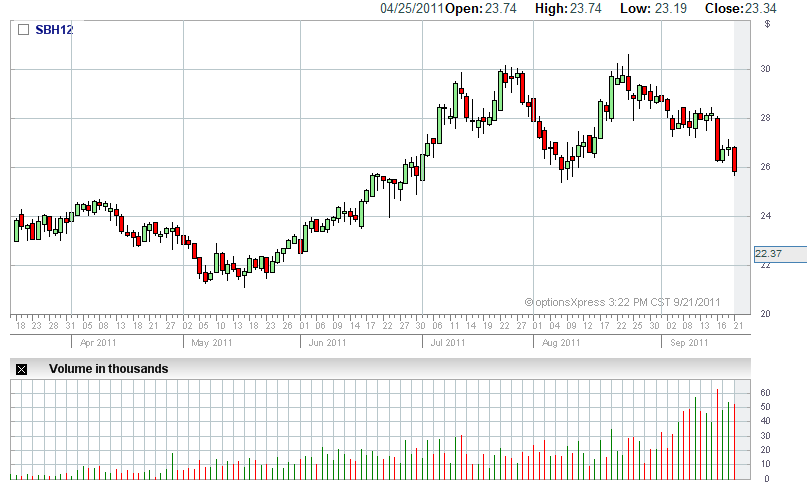
This situation represents trouble for the sugar bulls as the market is heavily long sugar. The sugar market is also at a key technical level. See chart below


March Sugar is currently trading at 25.84, which is just above the early August low of 25.38. If sugar fails to hold this level than it exposes 24 as the next downside target. If 24 is breached then we could see sugar fall to 22.

Volume, as you can see from the chart is starting to pick up as spec longs sell their losing positions. Adding to the bulls' woes, the CME's margin hike made it a little more expensive to hold sugar.

I remain short Sugar.

Black Swan Insights
Read more >>

Share/Bookmark

Shorting Sugar


With the market gyrating back and forth with no real conviction either way, I have been looking for uncorrelated trades, which can protect me from the non-stop risk on/risk off algo controlled market. Well I think I have found an interesting short opportunity: Sugar. 

Below is a chart of SGG, the ETF which tracks Sugar. 


You can see from the technical setup that Sugar is looking very heavy, with a possible double top pattern. Along with a weak technical picture, Sugar also faces poor fundamentals. The market is expected to be in surplus of at least 5 million tons for the 2011/2012 season. The only news that supports the market is a lower than expected harvest out of #1 exporter Brazil. However, this decline in output will be easily offset by record crops in Thailand, Europe, and India, along with strong harvests out of Russia and Ukraine. So we have a situation where the price of sugar has been bid higher on Brazilian crop concerns, but this should be short lived as market participants realize that the market will be well supplied. 

Another reason I like this trade is because sugar has a very low correlation with the stock market (around 0.1), which provides at least some diversification.

Finally, the sugar market is dominated by long speculators right now. Non-commercial traders are currently long 155,000 contracts, meaning that they will be quick to sell on any decline. Another bearish indicator is the fall in open interest, signaling a lack of conviction in this latest up move.

The trade is pretty simply. Short SGG with a stop at 105. 


UPDATE 9/16/2011---Well obviously I got really lucky on my timing on this trade. At the time of this writing 11:18 am pst, Sugar is down over 5% on a Canplan report, which suggests the Brazilian sugar crop will be stronger than expected. I am still short. There will much more long liquidation in the days to come.

Black Swan Insights   

Disclosure: I am short SGG at 100.40
Read more >>

Share/Bookmark

Merger Arbitrage Opportunities---Free Money....But

With the recent chaos in global markets, merger arbitrage spreads have widened considerably. This has made the risk/reward more favorable, allowing enterprising investors to take advantage. Below are some of the best opportunities in the merger arbitrage area:


From Dow Jones


Varian Semiconductor Equipment Associates Inc. (VSEA), Applied Materials Inc.(AMAT) 
 
Premium offered: $1.03 or 1.66% 
Acquirer: AMAT 
Target: VSEA 
Offer per share: $63.00 cash 
Value of outstanding common equity: $4,752,090,000 
Target share price: $61.97 
Acquirer share price: $11.05 
Expected closing: End Of 2011 9/25/2011 (might be October at the latest) 
Annualized gain: 37.92% 


Motorola Mobility Holdings, Inc. (MMI), Google Inc. (GOOG) 
 
Premium offered: $2.40 or 6.37% 
Acquirer: GOOG 
Target: MMI 
Offer per share: $40.00 cash 
Value of outstanding common equity: $11,772,000,000 
Target share price: $37.61 
Acquirer share price: $533.51 
Expected closing: End 2011-Early 2012 1/1/2012 
Annualized gain: 20.39% 

I don't normally like merger arbitrage because the risk is generally too high and the reward is too low. However, with these kind of annualized returns and ZIRP by Banana Ben and his merry traitors at the Fed, these look like good opportunities, without having to bet on the direction of the stock market. After all, anything is better than 0% at your bank. 

Warning: Merger Arbitrage often seems likes a sure thing...and it is until one of the deals falls through and you watch the stock drop 20-30%. The deals listed above are both all cash deals and have a very high likelihood of going through. But no guarantees. 
  
Black Swan Insights
Read more >>

Share/Bookmark

Marc Faber's September Outlook: The Calm Before the Storm


Marc Faber is out with the latest issue of his famous Gloom, Boom, and Doom Report which is always a must read for serious investors. Unlike most of the other talking heads, Faber has an excellent track record. He correctly predicted the top in the equity markets in Nov 2007 and caught the bottom in March 2009, making his subscribers a lot of money. Here is a summary of his September 2011 report:


1. Stocks---Faber says stocks face two potential outcomes: a brief rally to between 1250-1300 on the SP 500 before another leg down (and breaching the 1101 low) or a prolonged trading range with 1100 being the low and 1300 as resistance. Faber thinks the first outcome is more likely, but this could change depending on Fed policy (aka: money printing). Another reason for Faber's bearish posture is the unfavorable seasonality of September (worst month for stocks historically). Investors who have exposure to stocks should use any bounce to sell. If you feel compelled to own stocks, Faber recommends blue-chip stocks like Pepsi and Johnson and Johnson.


2. Gold--Extremely overbought at this level. Could fall to $1500-1600 range during the correction. Faber noted the bizarre relationship between US treasuries and gold. Concludes that the people buying gold were not worried about inflation but a collapse of the entire financial system. Gold should be viewed as more of an insurance policy rather than an inflation hedge. Long-term gold is going significantly higher. Gold stocks may be the better bet than the physical metal in the short-term as they play catch up.


3. US Treasuries--After a huge, fear-inspired rally, US treasuries are extremely vulnerable to a correction. Faber notes that the Daily Sentiment Index is around 98%, indicating a possible top. Furthermore, the "dumb money," a.k.a. the retail crowd, is very bullish judging by their positioning in the Rydex inverse government bond fund. If you own Treasuries, now is time to take profits.  


4. Indian Equities (Sensex)--While generally bearish on equities, Faber would advise the gradual accumulation of Indian shares, noting that they are relatively cheap and represent good value. Over a longer time frame (10 years), Faber thinks Indian stocks could appreciate 7%, which is pretty good compared to other investment options.


5. Macro--"This system has become completely corrupted and is being run for the benefit of the billionaires and banking CEO's who have control of the politicians." Faber has harsh words for Warren Buffett, noting that the investment guru profits not because of his genius, but at the expense of the American taxpayer. Buffett represents the very worst when it comes to crony capitalism. His BAC investment will likely prove very profitable, courtesy of the taxpaying middle-class and Buffett's straw man President whom he controls.


Happy trading!

Black Swan Insights

Read more >>

Share/Bookmark

Nasdaq Sentiment Index Hits All-Time Low---A Contrary Buy Signal?

The last time this indicator fell by so much was back on June 13 2011 when the NASDAQ sentiment index hit -194. We mentioned (see Negative Sentiment Suggests A Near-Term Bottom) that from a contrary perspective, this was a short term buy signal with the markets likely to rally. SPY was at 127 on June 13th. By July 7, SPY had risen all the way to 135.

Well it is that time again. The NSI has hit a new all time low of -342, showing just how much fear is currently priced into the market. This is a bullish signal for contrary investors who buy fear and sell euphoria as Jim Rogers would say.

I expect the market to trade sideways for a while before the new leg higher. Similar to what happened in late June of 2011. It would be hard to imagine a significant fall from these levels barring some kind of European Lehman event.

click chart for larger image.


Black Swan Insights
Read more >>

Share/Bookmark

Investment Ideas from the Barron's Roundtable


Find out what the word's top investors are doing with their money during these tumultuous times.

Bill Gross of PIMCO-- "Our best idea therefore is a 10-year Australian or Canadian bond. A 10-year Canadian government bond yields 2.5%. A10-year Aussie bond yields 4.5%. "

Marc Faber--In the near term the stock market is oversold, and a bounce to between 1240 and 1280 on the S&P 500 is possible. New highs above the May 2 high at 1370 are most unlikely for next six to 12 months.

I'm not buying anything right now. But if stocks dropped another 10% to 20%, I might add to the positions I mentioned in the Midyear Roundtable. I also maintain my recommendation to short Salesforce.com [CRM]

Gold is likely to correct, possibly by $100 or $150, but I continue to recommend gradual accumulation.

Archie MacAllaster-- I like some of the insurance companies more than the banks. Hartford Financial Services [HIG] has a book value of $43 a share, and the stock trades around 19. It yields more than 2%. Hartford raised its dividend this year to 40 cents a share from 20 cents, although it was a lot higher before the financial crisis in 2008. Hartford could earn $3 a share this year, so on a price/earnings basis it is very cheap.

Fred Hickey---  I stay with my secular bull-market play in gold. I own bullion and gold exchange-traded funds. The better opportunity right now is in gold-mining stocks. They have underperformed for a while. They are going to get a huge boost on price alone. I like Agnico-Eagle Mines [AEM], Newmont Mining [NEM] and Yamana Gold [AUY] for the second half of the year.

We were short since May a dozen semiconductor stocks, but I have covered them. I wouldn't be short anything now, because I don't know when the Fed is going to pull the trigger on QE.

Felix Zulauf ---I predicted in the Midyear Roundtable ("Buy Low, Stay Nimble," June 13) that
the stock market would go to a low in the fall. The next few weeks will be extremely volatile. I expect the market to go below the latest lows in September.

The central bank will come in to provide liquidity, but timidly at first because the Fed was bashed for QE2. After the fall low, equities will recover part of what they lost into the turn of the year and then fall again. Economies around the world most likely will be in recession next year.
Confidence in our currencies, policy makers and central banks is going down the drain. That will be reflected in a rising gold price. I have long said this isn't an environment for investing in stocks. Hold cash in the form of short- to medium-term Treasuries. Own a lot of gold, and don't have debt.

Mario Gabelli --The volatility we saw in the markets in May 2010 --  hedge funds trying to protect themselves using ETFs [exchange-traded funds] --  has returned, with the result that good and bad stocks are getting crushed. It is hard to figure out where to allocate and reallocate capital. On the other hand, we are getting pretty decent cash flows in certain products such as utilities, where we have taken advantage of the decline in stocks like NextEra Energy [NEE]. One position to which we have added is National Fuel Gas [NFG]. Shares of the company, which is partly a utility and partly a shale-gas play, fell to 55 from
75.
-------------------

I have failed to include Abbey Joesph Cohen's view because she is a certifiable lunatic who only gets paid to pump stocks to retail investors. As such, her opinion is worth less than rat excrement and would only serve to harm readers. 

Black Swan Insights
Read more >>

Share/Bookmark

Did We See the Plunge Protection Team Last Night?


Last night was a strange trading session. The Asian markets followed the US down. The Nikkei was off 4.5%, Kospi down 8%, and the ASX 200 was down 5%. As a result SP 500 futures plummeted another 28.50 points to around 1080. Then the unexpected happened--within a 20 minute period some massive buyer came in and starting lifting all bids in the market. The SP 500 futures almost immediately gained 14 points and went on to recoup all overnight losses. Then futures turned 1% higher. This is a stunning move considering the market was in free fall at the time.


I don't have any proof, but we may have just seen the plunge protection team in action. Just when everything in the world is going to hell, there always seems to be a mystery buyer come in to save the market. The huge move in the SP futures was not in response to any news, which makes the situation very suspicious. I doubt the SEC will ever investigate this considering how busy they are watching tranny porn (see ABC news article).

Oh well, back to your regularly scheduled market manipulation courtesy of the Fed.

Black Swan Insights  
Read more >>

Share/Bookmark

Charting the Stock Market Crash of 2011

Amazing charts show the massive carnage.

Here is a chart of the % of S&P 500 stocks above their 50 day moving average. We are at the same crash levels back in October of 2008.


S&P 500 stocks above 200 day average--its low, but has been lower.


The CBOE Equity put/call ratio--generally a contrarian indicator. We are near the highs reached back in 2008. Everybody wants to buy puts near the bottom.


The VIX--otherwise known as the fear index shows the real fear in this market. We either get a Lehman event or we are near capitulation.


SP 500 Bullish sentiment--not near the lows seen during October 2008 or March 2009, but getting very close.


Baltic Dry Index--used to be a good leading indicator. It is hovering just above 2008 lows.


Based purely on technicals, the market has only been this oversold twice:  5/21/40 & 10/19/87.  The SPX was +9.4% and +8.1% a month later according to Sentimentrader.com

While the AAII investor sentiment will be released on Thursday--we can imagine that it is somewhere around 5% bullish and 95% bearish.

Comment: Don't listen to the fools on CNBC saying it is time to be defensive--the time for that was 2 weeks ago before the crash. Now is the time to buy safe stocks for a tradable bounce in the markets. I like tobacco stocks and MLPs (with no commodity risk). 

Black Swan Insights
Read more >>

Share/Bookmark

Economy on the Brink--The Fed's Next Move


With the Fed meeting tomorrow, everyone wants to know what the Fed's next move after this dramatic crash. This is a re post of a previous article which explains the Fed's options during a liquidity trap.

1. Dramatically Change Price Expectations---Recent Fed announcements indicate that they want a 2-3% inflation rate compared to the current 1% rate. One idea is for the Fed to increase its inflation target upward to between 4-6%. To support this new policy the Fed could openly announce that they are monetizing debt rather than calling their money printing--credit easing. The Fed could also buy new kinds of assets such as stocks, corporate bonds, land, etc. This could have the effect of stimulating spending as consumers and businesses fear the loss of purchasing power. It would make it clear that the Fed is serious and will do everything in its power to create inflation.

2. Cap Treasury Rates (Aka. Operation Twist)--Under this policy option the Fed would agree to cap treasury rates at unreasonably low rates (e.g 10 year at 2.0% and 30 year at 3.5%). They would openly announce the target to the market and state that they will print as much money as necessary to achieve the goal. This would have the effect of lowering the real inflation adjusted yield of the 10 year to below zero. It would reduce the incentive for financial institutions to hold Treasuries and force them to do something with their money.

3. Taxing Currency---- Under this option the government would tax the currency, meaning that the dollar would automatically lose value over a period of time (say 3% every 6 months). This would create a cost to holding currency, giving people and institutions an incentive to spend it quickly, which would increase the velocity of money throughout the financial system. An extreme example of this policy would be the introduction of a new currency, which would lose a certain amount of value over a fixed period of time. The Japanese government considered this option in 1999, but never implemented it.

4. Negative Interest Rates--Like taxing currency, this option imposes a cost to hold money and theoretically forces people and corporations to spend money, which would increase aggregate demand. However, this is a hard policy to implement from a political perspective. It could lead to a flight of capital from the US as savers abandon the dollar for foreign assets. Under this policy option you may have to implement capital controls. What could work is for the Fed to impose negative interest rates on bank deposits held at the Federal Reserve. They could also prevent banks from passing along negative interest rates to consumers. Banks would be forced to do something with all of the money they are hoarding. This policy option would give banks an incentive to lend to the economy.

5. Reduce the Interest Paid on Excess Reserves---One reason QE failed was because banks simply held onto all of the excess reserves created by the Fed. All of this money is simply sitting around doing nothing for the economy. The Fed could reduce the rate it pays on these excess reserves, thereby creating an incentive for the banks to lend the money. While this appears to be a logical policy option, it is not practical because the major banks are largely insolvent. They need the capital to cushion themselves from future credit losses. Even if the Fed was to reduce the rate paid on reserves to 0%, it would not be enough to encourage the banks to lend out the money.

6.Extend Duration of Balance Sheet--Under this option, the Fed would start to move its bond holdings into longer dated Treasuries. The idea would be that the Fed would indicate to the market that it is going to maintain easy monetary policy forever. However, this action would be a de facto admission that QE 1, QE 2  was debt monetization. The last bit of confidence left in the dollar would collapse . The whole goal of QE was to con Americans and foreigners into believing QE was temporary and would be reversed at a later time (readers know better than that). If the Fed starts buying 30 year treasuries, it collapses the illusion forever.  

7. Helicopter Drop Money--The easiest way to stimulate aggregate demand is to print money and hand it out to the general population. Imagine everyone in the US getting a check for $25,000. This would automatically create inflation and increase spending. It would also increase inflation expectations, which the Fed considers important. The major drawback is that nobody knows how much inflation this would cause and it might lead to hyperinflation.

As you can see the Fed is not out of bullets. Zimbabwe Ben and his fellow counterfeiters will stop at nothing to create inflation and destroy the value of the dollar, all in the name of saving the economy.

Black Swan Insights
Read more >>

Share/Bookmark