Don't Believe the Hype: Apple is Not a Cheap Value Stock

A quick blurb about Apple's earnings.

Apple reported earnings last night which beat already lowered expectations. Little surprise. Under-promise over deliver as usual. However, guidance was very poor. That has not stopped the usual Apple groupies from proclaiming that Apple has become a value stock with a growing dividend and share buybacks. This is completely false.

On the surface Apple appears to the layman cheap. Compared to 2013 earnings expectations, Apple trades at a 9 P/E and a forward P/E of 8.3. What more could a value investor want? The reason that Apple is trading at a low valuation because everyone expects earnings to decline in the future. This is a key aspect which most investors fail to realize. When a non-cyclical stock trades at a P/E of lower than 10, the market is expecting declining earnings--analysts just have not realized this yet. In fact the market is expecting a sharp decline of at least 20% compared to analyst's 49.00 in earnings expected for FY 2014. The concept that Apple is cheap is noting more than a stock market mirage created to suck in low-informed investors into a massive value trap. If anything, Apple is a short not a buy at $414 a share. Expect it to steadily decline over the next year as more and more investors realize that the growth will disappoint to the downside.

And remember--those stock buybacks are nothing more than a waste of shareholder money. Buying back stock at inflated prices when earnings are declining is a recipe for disaster. I pity anyone owning Apple (e.g Greenlight Cap and about a billion other hedge funds). The Apple Titanic is sinking, better abandon ship before the whole thing sinks and there wont be enough lifeboats for everyone.

Black Swan Insights.

Read more >>

Share/Bookmark

AP's Fake Terror Tweet: The Beginning of For-Profit Terrorism?

Historically, most terrorism was committed for ideological reasons, but now a new form of terrorism may be emerging: for-profit terrorism.

On April 23 2013 AP's widely followed Twitter account was hacked and falsely reported that an explosion had occurred at the White House injuring President Obama. Normally such a report would have little impact, but with 2 million followers, AP's tweet translated into real world consequences for US financial markets. Before the false tweet, US markets were enjoying a rally of about 130 points on the Dow and 14 points for the S&P 500. Within 3 minutes of the fake AP tweet, the S&P 500 had crashed 13 points with large gaps seen in many stocks. Zerohedge reports that during that time 260,000 S&P contracts traded with a notional value of $20.4 billion. A large amount of money was made and lost during this time, all because of a fake news report on a twitter account. While this instance was isolated and minuscule in the general course of the stock market, it may mark the beginning of a disturbing new trend where terror is used for financial gain.

The rapid dissemination of information through mobile and social media is a double-edge sword. People are more connected to their friends, families, and employers despite living 1000's of miles apart in some cases. Information is no longer controlled by a top-down mainstream media hierarchy which was vetted by editors and producers before dissemination to the masses. Instead information can now be transmitted almost instantaneously be anyone with an Internet connection, bypassing traditional forms of media such as TV or radio which had controls to prevent false or unsubstantiated stories from breaking. This new form of unedited information has the same power to change the course of events as traditional mainstream media information. Malicious actors (whether state-sponsored or independent) could use this new technology to make money.

Consider the following example. A man in Times Square starts shouting that the President has been shot and is dead. He runs around telling everyone that he has a source at the White House that told him this was true. What would be the effect of this false statement? Most likely nothing. Some by passers may get upset and call the police to report the deranged man for making threats against the president. The point being that no real world impact occurred. Most likely, the event will be considered a non-event and not covered by the media.

Now consider another example. Hedge fund Alpha wants to make a quick buck in the stock market. Hedge Fund Alpha purchases the services of an accomplished hacker to break into the twitter account of AP and post a false report that "Terror in DC--the president shot and killed at public reception--- foreign terrorists thought responsible--Washington on lock down--more news coming". Knowing that this headline would cause the market to drop precipitously, Hedge Fund Alpha shorts a large amount of S&P 500 futures or buys puts. Within minutes, Hedge Fund Alpha has made millions of dollars and promptly closes its positions. After 10 minutes, information comes out that this was a false report and that AP's twitter account was hacked. The White House Press Secretary tweets that the president is fine and all is well in the West Wing. AP asks Twitter to suspend its twitter account in order to prevent further misinformation from occurring. The problem is that the damage has already occurred. Investors lost money as stocks plummeted, while Hedge Fund Alpha collected large profits. Keep in mind that this whole event happened in less than 10 minutes. What was the cost of this illegal hack operation for Hedge Fund Alpha? The answer is not much compared to the millions in potential profits. All the hedge fund had to do was to hire a hacker and not tell them what the hack attack was designed for. You could probably hire a computer hacker for a trivial amount (lets just say $50,000), provided they did not understand the goal of the operation.

The above example illustrates how simple and cost-effective this fake terror story could be generated and disseminated to the world. While the story was quickly debunked as a false news item, it succeeded in its objective by creating a temporary panic in the stock market,  allowing nefarious operators to make some fast money. While this fake terror scenario was relatively benign (e.g. no one was physically hurt or injured), the incident raises an important point regarding terrorism: it can be very profitable.

Now suppose Hedge Fund Alpha wants to go a step further and actually influence events by committing a low-scale attack against a specific company in order to profit from the events. In this scenario, the attack could be a cyberattack against a company which primarily relied on its website to make money (e.g. Amazon.com, Google, etc). This is not without precedent. Many companies over the last few years have reported denial of service attacks against their websites. However, for the most part these attacks are done by disgruntled low level hackers who take down the site for a few hours at most. Sometimes they post explicit or incorrect images on the website, like seeing a naked woman when you go to bankofamerica.com. Sure its embarrassing for the company, but does little to impact corporate profitability or stock price. Now imagine that a well financed organization with millions of dollars in capital engaged in a well coordinated and persistent attack which shut down Amazon.com. Just when Amazon thinks it has restored the website, the hackers slip a malicious virus into Amazon's network which artificially lowers the price on every item to $1. These kind of well planned attacks continue for 6 days until Amazon finally regains full website functionality. A few days later Amazon announces that the hack attack also resulted in credit card information on millions of customers to be stolen. This attack would have cost Amazon 10's of millions of dollars of profit and hundreds of millions in revenue, along with a serious breach of public trust in the company. There is no question that the stock could decline during the whole incident, a positive for anyone betting against the company through short-selling or puts.

While the above scenario is unlikely considering how large Amazon is and the thousands of computer technicians it undoubtedly employs, this is not the case for smaller companies who could not defend themselves against such an organized and persistent cyberattack. For smaller or weaker companies this attack could very well force them into bankruptcy. We have entered a new world where this type of scenario is possible.

Black Swan Insights


Read more >>

Share/Bookmark

MACRO UPDATE: Buy, Sell or Hold?

Well. I am finally back to the blog after a very long and pleasurable hiatus.

I am going to begin publishing a weekly survey of the current macro environment with my various trading positions and predictions.

1. S&P 500 Position: Neutral/with downside bias (e.g.would wait for a correction before buying stock).

If somebody put a gun to my head and forced me to by a stock I would chose a consumer staple stock over cyclical. The best stocks on earth are the tobacco stocks like Altria (MO) and Lorillard (LO). They pay 5% dividends which increase over time. They have a captive customer who is physically and mentally compelled to purchase their product. Buy. Hold. Reinvest Dividends. Retire Rich.


Furthermore, sentiment is too high as indicated by the NAAIM Manager Survey sentiment which currently stands at 85%. Anything over 80 indicates a top for the market.


2. Gold & Silver Position: Buy/Accumulate

Gold has corrected over the last few months and represents a good entry point. With the Fed promising to print money forever, why not own gold? I am happy that I get to buy gold on sale around $1580-1600. Furthermore, the large commercials have dramatically cut their short positions, indicating that they expect higher prices. HSBC noted that gold fundamentals remain positive because of "rising global liquidity as the likes of the Bank of Japan ramp up quantitative easing, rising inflation expectations, currency depreciation and geopolitical tensions."


Furthermore, the Cyprus crisis is likely to keep a bid under gold writes UBS:

"For now, the risk of immediate contagion to otherperipheral countries remains limited, but the Cyprus precedent certainly cannotbe shrugged off particularly if things deteriorate elsewhere...As people start to worry about the safety of their deposits, gold would become an attractive alternative and an escalation of these worries would prompt a return of fear-related physical buying."

3. Oil Position: Sell/Short

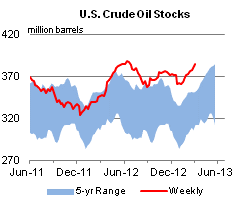
Too much oil and not enough places to put it sums up the oil market. The chart below shows the surplus amount of oil slushing around the US. US oil consumption is declining and production is growing. Not a good combination for Crude oil. Furthermore, speculators are long crude, which means it is likely to go down. Always fade the crowd my friends. It is not a guaranteed win, but puts the odds in your favor.


And this trend of massive over-supply is expected to worsen: "According to early estimates from four analysts surveyed by Dow Jones Newswires, U.S. crude oil inventories rose by 1.1 million barrels in the week ended Friday"

4. Treasuries Position: Neutral

No reason to buy treasuries. The Fed is manipulating the market with its "QE till we all die" policy. Rates will remain low despite the improvement in the economy and higher inflation expectations. There is no bond bubble and it will not burst. The Fed will not allow this. If you are dumb enough to own Treasuries beware. The government is printing money to debase the dollar. You will always get your principal back with interest, but will likely lose substantial purchasing power due to inflation in the future.

5. Residential Real Estate Position: BULLISH BULLISH BULLISH.

If you can qualify for a 4% or less mortgage, this is the best time to buy a home. The Federal Reserve led by kamikaze Ben Bernanke has lowered mortgage rates to near all-time lows. If you buy a house, you are in essence betting on inflation which is exactly what the Fed is trying to engineer. This bet is going to pay off for you in a huge way in the future. You would have locked in a super low interest rate of 4% when historical inflation is 3%. This means that in real inflation adjusted terms, you are borrowing money for 1%. Great deal for consumers. Furthermore, with the illegally printing money, homes prices should increase over the next 1-5 years substantially (10-20%). If you put 10% down, a 10% increase doubles your investment.

6. Trade for the Week Position:

 Buy Imperial Tobacco (ITYBY.pk) This is the ADR for Imperial Tobacco company which is a large multinational tobacco company with steady profits and addicted customers. Not a bad combination. The stock has strong support at $70.40. I expect a bounce to $73.50.


Happy Trading Everyone!

Black Swan Insights
Read more >>

Share/Bookmark

Buying GLD: A Golden Opportunity For Contrarian Investors

Back from hiatus. As frequent readers will remember, gold remains a core part of my portfolio (since the beginning of QE madness from the FED). However, from time to time I will take a trading position in the yellow metal when opportunities present themselves. Well, that time is now upon us. I am buying GLD.

Why?

Gold has been in a downtrend since reaching its high back in 2011 around $1913. Recent selling has been initiated on the (I believe) false assumption that QE 3 is off the table. Wrong! Another month of weak unemployment numbers will almost certainly force the Fed into more QE (maybe sterilized in some form) to force long term interest rates even more. QE=Money Printing=Dollar Debasement=Higher Nominal Asset Prices. No rocket science here. 

However, the market has failed to realize that QE is back on the table. This case is especially true in Europe where the ECB will be forced into doing more to stop the bleeding. The European public does not want more austerity (outside of Germany). They want more government spending financed by money printing. ECB will initiate more QE or expand its current refinancing operations. 

Sentiment on gold is extremely negative which from a contrarian perspective is positive. According to the Hulbert gold newsletter sentiment index (a collection of market timers) the crowd is now short gold-- Here is an excerpt, "Today, in contrast, it is at minus 14.8%, which means that the average gold timer is now allocating about a seventh of his gold-oriented portfolio to shorting the market."

As usual these professional market timers are almost always wrong. They are bullish at the top of the market and bearish at the bottom. So I will be happy to buy when they are shorting.

Obviously, gold could go lower, but the odds favor that we are approaching a major bottom in gold.


Black Swan Insights
Read more >>

Share/Bookmark

Scared To Death: Investment Manager Sentiment Plummets to March 2009 Levels


Considering that the market has done nothing for the last few weeks, except bounce up and down in a very tight range, one would think that sentiment has cooled off from August's market crash. You would be wrong. The NAAIM sentiment survey released today shows that investment managers are practically on the ledge and ready to jump to their own deaths to escape this vicious market turmoil. Apparently, they just realized that their end of year bonus is not going to be filled with gold or jewels, but instead with a lump of coal thanks to their poor performance. NAAIM sentiment came in at 4.18, a level not seen since the March 2009 lows. This also means that investment managers are so depressed that they are almost completely net short (with leverage). It should be remembered that this is a contrary indicator. You generally make money by doing the exact opposite of these pigeons. Right now it is saying that we may be nearing an important low in the market. This is quite interesting because other sentiment indicators like the AAIII poll are not confirming excessive bearishness.

One thing to keep in mind when trying to use this indicator for market timing. Back in March 2009 when the market was bottoming, the NAAIM survey held below 10 for three weeks. So it is not a perfect timing indicator, but certainly one worth following.

3/4/2009      2.15
3/11/2009    4.23
3/18/2009    9.97


Black Swan Insights
Read more >>

Share/Bookmark

Quick Update: Closing Sugar Short

All good trades must come to and end as they say. The time has come for my Sugar short. I caught a nice 14% downside move that was pretty much straight down. It would be piggish of me to press the short any further. When you trade on leverage, you cannot risk a large oversold bounce (you never know if it is the beginning of a large move higher or just a technical bounce).

So why did this trade work so well? Luck. When I shorted sugar the fundamentals were beginning to sour along with a negative technical backdrop. Furthermore, all soft commodities were weak during this period, which pressured sugar lower. In short, the general conditions favored lower sugar prices.


I might consider shorting sugar again on a possible bounce higher.

Related Articles

Shorting Sugar
Update on the Sugar Short


Black Swan Insights
Read more >>

Share/Bookmark

Will the EU Bailout Save the Market? Be Careful What You Wish For


The endless and increasingly desperate rumors of an EU bailout was enough to juice the stock market higher today. The Dow closed up over 270 points. To me, this has ominous parallels to the October 2008 Tarp bailout of the banks. If you remember the market initially dropped when the US House of Criminals Representatives failed to surrender complete sovereignty to the major banks. A few days later, the big banks made the right payments to the right people to get the TARP bailout approved despite public opposition to the plan. Anyway, the key takeaway was that the stock market immediately began to crash after the passing of the TARP bill. Instead of restoring confidence, the bailout bill spooked the market. People started to freak out that the US financial system must be in deep trouble if it needed $700 billion in additional capital. After all, every Government official and Fed member had assured the market that "the fundamentals remain sound" and other lies.

Below is a chart of the S&P 500 between October 3, 2008 (when the TARP bill was approved) and October 17,2008. The market crashed 22% despite the bailout. The lesson from 2008 was that bailouts don't prevent markets from crashing. Are we repeating history?


Black Swan Insights
Read more >>

Share/Bookmark

Update on the Sugar Short

A few days ago I mentioned that Sugar was a good short from both a fundamental and technical view. So far the trade has done well. The longs are currently in liquidation mode as market sentiment has changed dramatically. A few weeks ago the bulls were focusing on Brazil's weak crop estimates. Now, everyone is worried about the expected global sugar surplus of between 4-7 million tons for the 2011/2012 season. Furthermore, the risk on market sentiment has been turned off courtesy of Europe's financial implosion.

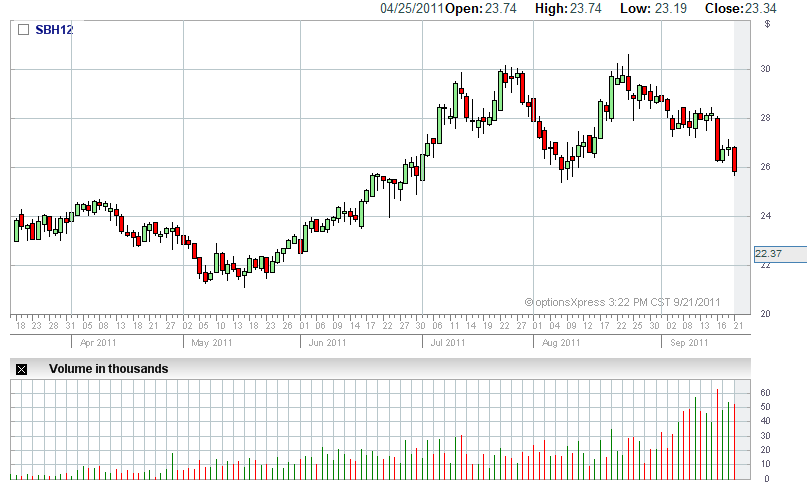
This situation represents trouble for the sugar bulls as the market is heavily long sugar. The sugar market is also at a key technical level. See chart below


March Sugar is currently trading at 25.84, which is just above the early August low of 25.38. If sugar fails to hold this level than it exposes 24 as the next downside target. If 24 is breached then we could see sugar fall to 22.

Volume, as you can see from the chart is starting to pick up as spec longs sell their losing positions. Adding to the bulls' woes, the CME's margin hike made it a little more expensive to hold sugar.

I remain short Sugar.

Black Swan Insights
Read more >>

Share/Bookmark

Shorting Sugar


With the market gyrating back and forth with no real conviction either way, I have been looking for uncorrelated trades, which can protect me from the non-stop risk on/risk off algo controlled market. Well I think I have found an interesting short opportunity: Sugar. 

Below is a chart of SGG, the ETF which tracks Sugar. 


You can see from the technical setup that Sugar is looking very heavy, with a possible double top pattern. Along with a weak technical picture, Sugar also faces poor fundamentals. The market is expected to be in surplus of at least 5 million tons for the 2011/2012 season. The only news that supports the market is a lower than expected harvest out of #1 exporter Brazil. However, this decline in output will be easily offset by record crops in Thailand, Europe, and India, along with strong harvests out of Russia and Ukraine. So we have a situation where the price of sugar has been bid higher on Brazilian crop concerns, but this should be short lived as market participants realize that the market will be well supplied. 

Another reason I like this trade is because sugar has a very low correlation with the stock market (around 0.1), which provides at least some diversification.

Finally, the sugar market is dominated by long speculators right now. Non-commercial traders are currently long 155,000 contracts, meaning that they will be quick to sell on any decline. Another bearish indicator is the fall in open interest, signaling a lack of conviction in this latest up move.

The trade is pretty simply. Short SGG with a stop at 105. 


UPDATE 9/16/2011---Well obviously I got really lucky on my timing on this trade. At the time of this writing 11:18 am pst, Sugar is down over 5% on a Canplan report, which suggests the Brazilian sugar crop will be stronger than expected. I am still short. There will much more long liquidation in the days to come.

Black Swan Insights   

Disclosure: I am short SGG at 100.40
Read more >>

Share/Bookmark

Merger Arbitrage Opportunities---Free Money....But

With the recent chaos in global markets, merger arbitrage spreads have widened considerably. This has made the risk/reward more favorable, allowing enterprising investors to take advantage. Below are some of the best opportunities in the merger arbitrage area:


From Dow Jones


Varian Semiconductor Equipment Associates Inc. (VSEA), Applied Materials Inc.(AMAT) 
 
Premium offered: $1.03 or 1.66% 
Acquirer: AMAT 
Target: VSEA 
Offer per share: $63.00 cash 
Value of outstanding common equity: $4,752,090,000 
Target share price: $61.97 
Acquirer share price: $11.05 
Expected closing: End Of 2011 9/25/2011 (might be October at the latest) 
Annualized gain: 37.92% 


Motorola Mobility Holdings, Inc. (MMI), Google Inc. (GOOG) 
 
Premium offered: $2.40 or 6.37% 
Acquirer: GOOG 
Target: MMI 
Offer per share: $40.00 cash 
Value of outstanding common equity: $11,772,000,000 
Target share price: $37.61 
Acquirer share price: $533.51 
Expected closing: End 2011-Early 2012 1/1/2012 
Annualized gain: 20.39% 

I don't normally like merger arbitrage because the risk is generally too high and the reward is too low. However, with these kind of annualized returns and ZIRP by Banana Ben and his merry traitors at the Fed, these look like good opportunities, without having to bet on the direction of the stock market. After all, anything is better than 0% at your bank. 

Warning: Merger Arbitrage often seems likes a sure thing...and it is until one of the deals falls through and you watch the stock drop 20-30%. The deals listed above are both all cash deals and have a very high likelihood of going through. But no guarantees. 
  
Black Swan Insights
Read more >>

Share/Bookmark